


One million electric kilometres: nox drives forward the decarbonisation of express logistics
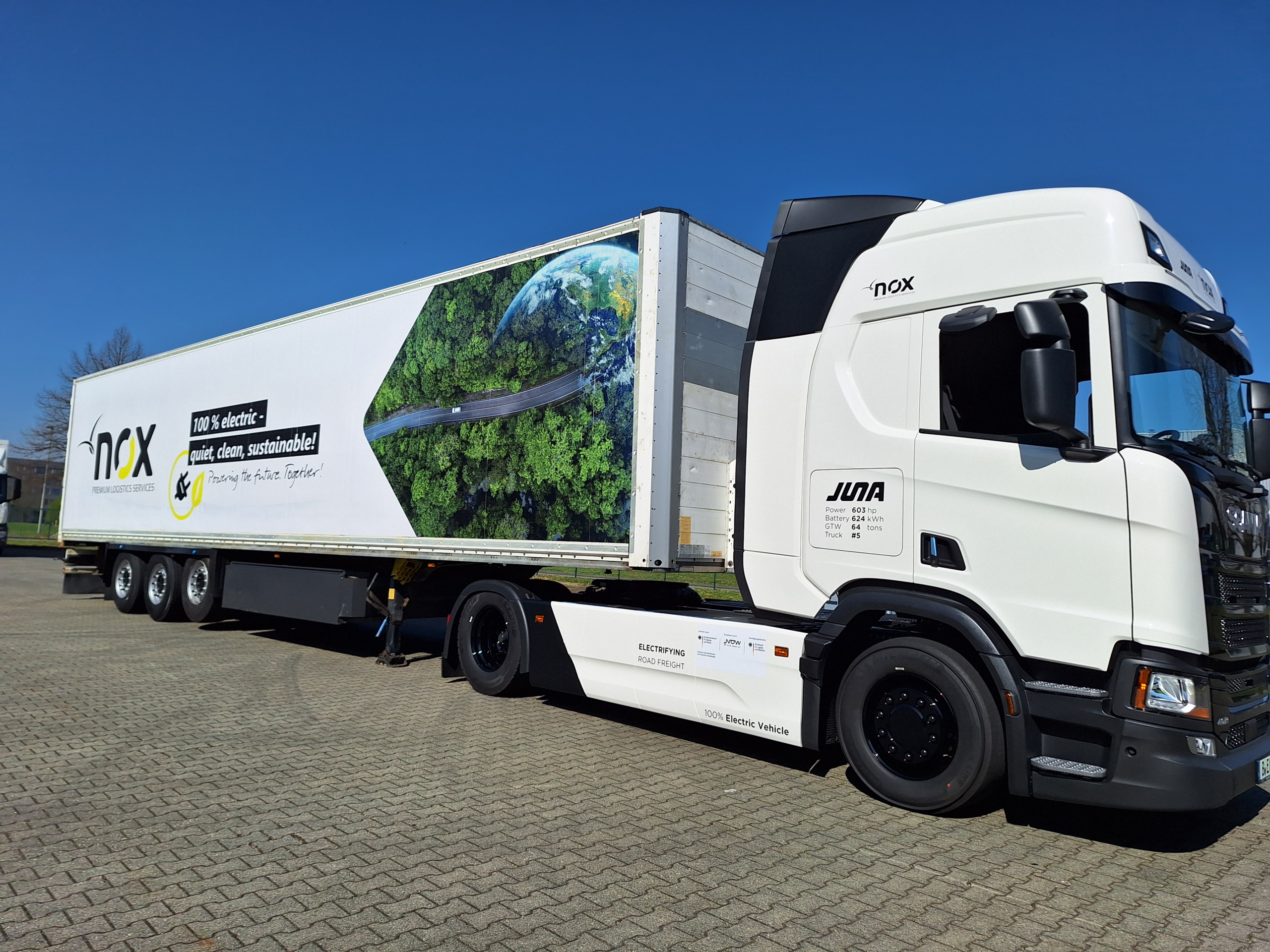
nox Germany GmbH has, for the first time, surpassed the one-million-kilometre mark for electric driving within its innight network. This milestone demonstrates that electric mobility can be successfully deployed to an increasing extent even in time-critical heavy goods transport and makes an important contribution to the decarbonisation of logistics processes.
But what does one million electric kilometres actually mean?
- Almost 25 trips round the Earth at the equator
- More than 13 trips to the Moon and back
- Around 300,000 litres of diesel that a comparable diesel lorry would have consumed over this distance
- Around 32,000 to 80,000 trees would need to grow for a year to absorb the resulting CO₂ emissions (approx. 795 tonnes of CO₂ that would have been produced by direct diesel operation)
The project was launched on 27 March 2025. Together with transport partner Kuhlmann and project partner JUNA, the first electric tractor unit was deployed in Scania’s daily factory transport operations between Germany, Belgium and the Netherlands. Within a few months, a pilot project had evolved into a scalable concept for electric heavy goods transport within nox’s innight network.
Today, 14 electric trucks from four transport partners are already on the road daily for nox. They connect depots, customer sites and hubs in Germany and the Benelux countries, making an active contribution to reducing emissions across the network.
“For us, one million kilometres are far more than just a figure. It shows that electric mobility can already operate economically and reliably in heavy-duty distribution and scheduled transport. What is particularly remarkable is that we have reached this milestone without our own charging infrastructure,” explains Daniel Reinshagen, Senior Director of Partner Management & Procurement at nox.
Every night, nox transports more than 100,000 time-critical shipments across Europe, covering around 400,000 kilometres in the process. Deliveries are made before the start of the working day and support numerous sectors – such as the automotive, agricultural, construction, medical technology and renewable energy industries – by ensuring a reliable supply of time-critical spare parts and components.
The expansion of the electric fleet is continuing apace. By the end of 2026, the number of electric trucks in operation is set to rise to more than 25 vehicles. As a result, nox expects a reduction in CO₂ emissions across its network of around ten per cent compared with 2025.
At the same time, the company is investing in the expansion of the charging infrastructure together with its transport partners. The first partners are already installing their own fast-charging points at their sites. Furthermore, nox is planning strategic charging hubs designed to enable charging during loading and unloading operations and to support the further electrification of regular services.
“The transformation of road freight transport is not happening sometime in the future. It is already taking place on Europe’s roads today. The experience of recent months shows that the technology is operational and that scaling up has begun,” said Reinshagen.
These activities form part of the sustainability strategy of the Groupe STERNE, of which nox has been a part since 2022. The group’s climate targets have been scientifically validated by the Science Based Targets initiative (SBTi) and are aligned with the 1.5-degree target of the Paris Agreement.
You can find more details in our german press release.
